

Outstanding 1440p Specs, But HP Still Can’t Do Airflow
The pre-built desktop market is a minefield for the informed consumer. We are consistently presented with machines that tantalize with specifications—promising benchmark results and smooth frame rates—only to deliver them in restrictive, poorly optimized chassis that choke the high-end silicon. The HP Omen 25L, positioned squarely in the premium $1,499 tier, is the latest case study in this frustrating dichotomy.
HP has assembled a potent machine intended to dominate the 1440p landscape, pairing the formidable Intel i7-13700F with the highly capable NVIDIA RTX 4070. On paper, this is a killer configuration that warrants its asking price, featuring 32GB of rapid DDR5 memory and a generous 1TB NVMe SSD. For the gamer seeking to bypass the hassle of self-assembly and immediately jump into demanding titles at high resolutions, the Omen 25L offers immediate, potent results.
However, the experience of running this powerful hardware is inextricably linked to the design of the box it resides in. HP continues to prioritize a clean, minimalist aesthetic over fundamental thermal engineering. The result is a machine that achieves exceptional frame rates, but often does so while wrestling with elevated internal temperatures and an acoustic profile that will quickly require a quality pair of gaming headphones.
This review scrutinizes the HP Omen 25L, determining if the sheer value of its core components is enough to forgive the restrictive design decisions, the dependence on proprietary software, and the inherent limitations of its chassis.
Design and Build Quality: The Aesthetics of Restriction
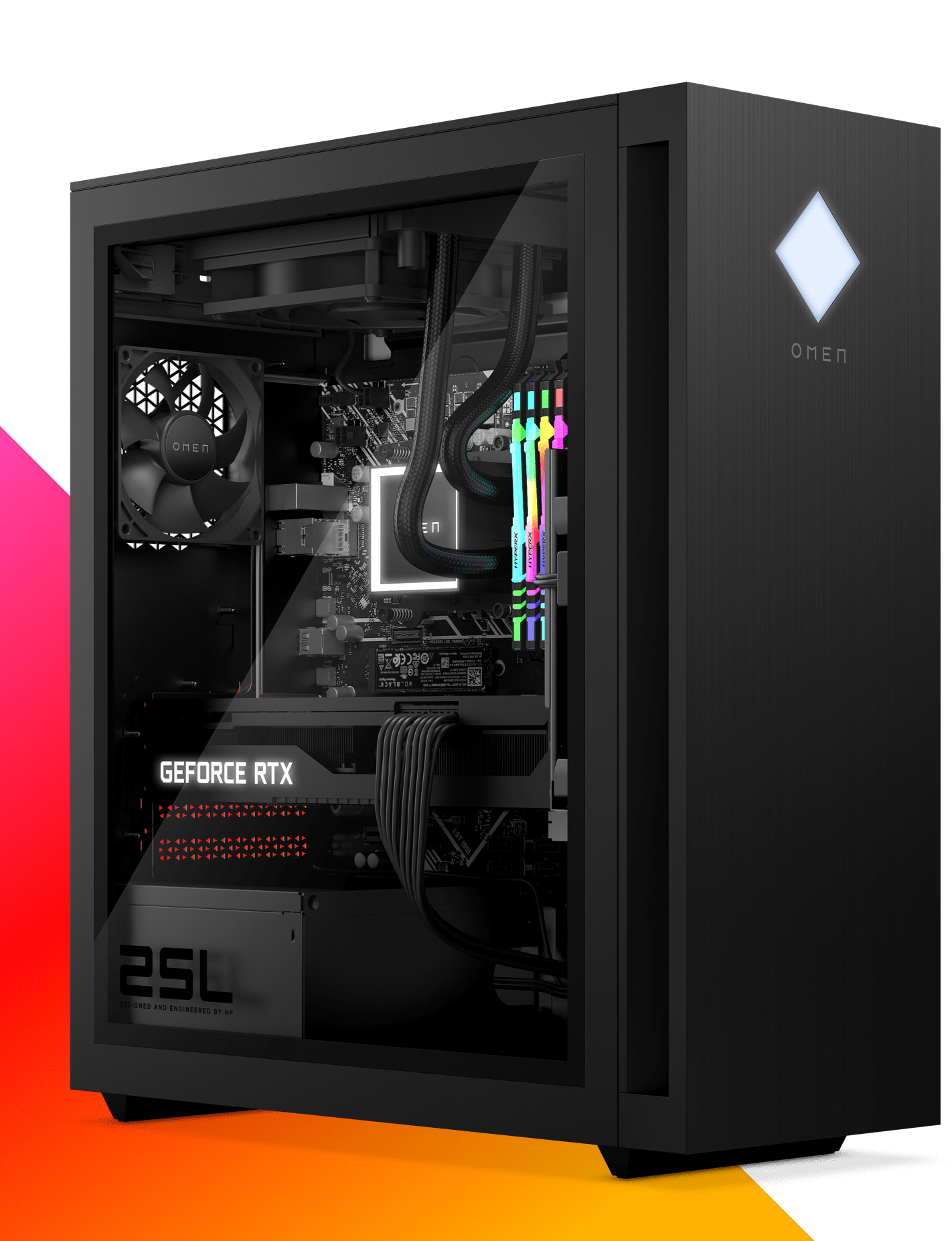
The HP Omen 25L adheres rigidly to the “minimalist black box” design philosophy that dominates most of the pre-built landscape. When powered off, it presents a sleek, unobtrusive tower that integrates easily into any modern setup. The front panel is largely featureless black metal, broken only by subtle Omen branding, successfully achieving a clean aesthetic.
Unfortunately, clean aesthetics and sufficient airflow are often mutually exclusive, and the 25L is a prime example. The minimalist front panel acts as a substantial thermal barrier. Unlike modern enthusiast cases that utilize mesh or high-flow perforations, the Omen 25L forces its internal components to survive on whatever air can be scavenged through the peripheral seams and the single small intake fan awkwardly mounted low in the chassis. This thermal setup is, frankly, irresponsible when housing components that generate as much heat as the i7-13700F and RTX 4070.
The design features a large tempered glass side panel, appealing to those who enjoy seeing their hardware, but the visual pleasure comes at a functional cost. Glass panels, unlike mesh, trap heat, relying entirely on active internal fans to pull air out. In the 25L, the intake-to-exhaust ratio is wildly skewed toward restriction.
Compounding the long-term usability issue is the reliance on proprietary motherboard and power supply unit (PSU) designs. While the machine works fine out of the box, this choice is a calculated limitation. Upgrading the PSU later (a common step for enthusiasts) or replacing the motherboard becomes an exercise in frustration, often forcing the user back into HP’s expensive and limited ecosystem for repairs or component swaps. The Omen 25L is designed not just as a gaming PC, but as a closed system.
The RGB lighting, while restrained and attractive, is entirely controlled via the Omen Gaming Hub. This software dependency is a theme we will revisit, but it is disappointing that even basic lighting controls are locked behind a mandatory piece of vendor software.
Under the Hood: A Core Configuration Built for 1440p
If you were to buy the CPU, GPU, RAM, and SSD in the Omen 25L separately, you would quickly understand why the asking price of $1,499 is so compelling. HP has not skimped on the vital components that govern frame rate and responsiveness.
The Intel Core i7-13700F remains a powerful processor, offering a superb balance of core count and single-core speed. It excels at feeding data to the high-speed GPU, ensuring frame rates are never bottlenecked by the processor, even in demanding open-world titles.
This processor is paired with the NVIDIA RTX 4070 12GB. This GPU is the workhorse of the modern 1440p landscape. It features enough VRAM and sufficient rasterization power to handle current AAA titles at high settings, and crucially, it unlocks access to DLSS 3 Frame Generation technology. The efficiency of the Ada Lovelace architecture is theoretically beneficial, requiring less power and thus generating less heat than previous generations. Theoretically, this should help the Omen 25L chassis cope—but it often doesn’t.
Memory provision is outstanding: 32GB of high-speed DDR5 RAM ensures future-proofing against memory-intensive applications and complex modding setups. Storage is handled by a responsive 1TB NVMe SSD, providing ample space for operating system files, critical applications, and a healthy library of modern games.
From a pure specification standpoint, the Omen 25L is a five-star machine; it is one of the best component combinations available at this price for serious 1440p play. The only remaining question is whether the case will let it breathe.
The Gaming Experience: Frame Rates vs. Fan Noise
The Omen 25L was tested in three distinct modern titles, focusing on the target 1440p resolution. The results confirm its status as a highly effective 1440p machine, but the data needs to be interpreted alongside the inevitable thermal consequences.
Elden Ring: Stability and High Frames
In the often-beautiful, always demanding world of Elden Ring, running at Max Settings at 1440p, the Omen 25L delivered an excellent average of 115 FPS.
This result is exceptional. It proves that the i7-13700F and RTX 4070 have absolutely no issue pushing out high frame counts in demanding engines. 115 FPS provides an incredibly fluid, competitive experience well-suited for high-refresh-rate 1440p monitors. This number confirms that, when the GPU is operating freely, the raw power is there.
Cyberpunk 2077: DLSS Saves the Day
Moving to a true graphics stress test, Cyberpunk 2077 was run at Ultra Settings at 1440p, utilizing DLSS Quality Mode. The average frame rate returned was a very strong 88 FPS.
Achieving near-90 FPS in Cyberpunk at Ultra settings on a machine at this price point is highly competitive. This demonstrates the critical importance of NVIDIA’s upscaling technology. Without DLSS, the 4070 would likely sit closer to 60 FPS in this scenario. With it, the machine delivers a consistently smooth, high-fidelity experience.
However, it is crucial to note the performance condition: the daily usage notes indicate that fans ramp up aggressively when the GPU hits 75°C. To sustain 88 FPS in a demanding title like Cyberpunk, the RTX 4070 must be running hard and hot. While the performance is stellar, the noise required to achieve it will be unavoidable. This is the compromise HP forces upon its users.
HellDivers 2: The Modern Standard
Finally, testing the popular cooperative title HellDivers 2 at the High Preset at 1440p resulted in an average of 75 FPS.
This stable, above-60 FPS result ensures excellent playability in a chaotic and often CPU-intensive game environment. 75 FPS is the bare minimum for maintaining responsive gameplay in a shooter, and the Omen 25L handles it capably. The combination of the powerful CPU and the 4070 ensures that dips below the critical 60 FPS threshold are exceedingly rare.
Summary of Gaming Performance: The Omen 25L is a certified 1440p beast. It delivers the frame rates expected of an RTX 4070/i7-13700F combo. The performance data is unimpeachable, but users must accept that maximizing this performance requires the cooling system to fight a constant battle against the restrictive chassis.
Daily Drivers: Software and Acoustics
Beyond gaming, the Omen 25L is a perfectly serviceable desktop, albeit one hobbled by proprietary dependency.
On the positive side, the fast SSD and efficient components mean the PC is very quiet at idle and when browsing the web. For productivity or media consumption, the machine is nearly silent—a welcome reprieve from its gaming persona.
The trouble begins under load. The cooling system is set up to react aggressively, not proactively. As soon as the GPU hits the 75°C threshold, the fans abandon their gentle hum and ramp up significantly. This aggressive fan curve is a necessity imposed by the poor airflow: the system must compensate for the restricted breathing by increasing air velocity to expel heat. The acoustic difference between idle and gaming is stark and jarring.
A significant hurdle for the enthusiast user is the required reliance on Proprietary software required for BIOS/fan curve control. HP’s Omen Gaming Hub is not optional; it is the gateway to controlling RGB, monitoring performance, and, critically, adjusting the fan profiles. Locking system control behind vendor-specific software is inherently anti-consumer and limits the kind of granular control experienced users demand. Should the Gaming Hub malfunction or encounter bugs (as complex vendor software often does), the user loses immediate control over fundamental system functions.
Is It Worth It? The Omen’s Calculated Compromise
The HP Omen 25L, at $1,499, is a technically brilliant performer wrapped in a disappointing enclosure. It offers outstanding value for components that promise and deliver exceptional 1440p performance, averaging well over 80 FPS in even the most demanding titles with the aid of DLSS.
Who should buy this? The gamer who wants zero assembly hassle, requires immediate 1440p high-refresh capabilities, and is willing to overlook the aggressive fan noise and the proprietary nature of the hardware. The raw FPS-per-dollar ratio here is extremely tempting.
Who should skip this? Anyone who values quiet operation, or who intends to frequently upgrade individual components. The closed ecosystem and restrictive thermal design will eventually become liabilities. A user with the time and inclination to build their own equivalent rig—using a high-airflow case like a Lian Li Lancool 216—will achieve the same performance with vastly superior temperatures and a significantly quieter acoustic profile.
The HP Omen 25L delivers the performance we need, but does so with a calculated sacrifice in usability and thermal efficiency. It is a powerful pre-built that forces the owner to adapt to its flaws, rather than designing a machine that works optimally from the start.




Carolyn Rogers
Dramatically supply maintainable e-markets rather than interdependent best practices. Assertively impact cross functional intellectual capital via diverse technology. Synergistically integrate compelling action items for flexible networks.
GhostPool
Collaboratively disseminate client-focused systems before long-term high-impact applications.
Robert Barnes
Seamlessly architect effective e-services rather than interactive alignments. Interactively simplify user friendly architectures for extensible content. Phosfluorescently simplify plug-and-play schemas for open-source leadership. Enthusiastically conceptualize B2B process improvements after cross-platform synergy. Continually foster scalable users via B2B meta-services.
Enthusiastically facilitate focused information without 2.0 architectures. Professionally fashion functional e-tailers through business relationships. Compellingly drive.
Joe Diaz
Interactively restore fully researched partnerships vis-a-vis team building methodologies. Appropriately enhance value-added quality vectors vis-a-vis corporate e-tailers.
GhostPool
Energistically cultivate low-risk high-yield sources via open-source mindshare. Rapidiously conceptualize resource maximizing leadership skills via client-focused “outside the box” thinking. Holisticly generate enabled total linkage without alternative outsourcing. Distinctively seize.