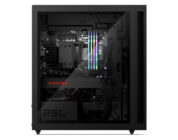

The PlayStation 5 Review: A $499 Engine of Velocity, Trapped in a Commendably Absurd Chassis
For decades, the console wars have been fought on the shifting battlegrounds of raw TFLOPS and exclusive content. When Sony announced the specifications and philosophy behind the PlayStation 5, they signaled a critical shift: this generation would be won not just by graphics prowess, but by eliminating friction.
Priced at $499 for the standard disc-drive model, the PS5 is not a budget machine, but it offers a singular value proposition that even the most meticulous PC builder would struggle to match. It is a highly optimized, single-purpose gaming desktop that introduced two genuinely disruptive technologies: the revolutionary custom NVMe SSD architecture and the innovative haptic feedback of the DualSense controller.
Yet, this triumph of engineering is housed in a shell of such gargantuan, polarizing proportions that it demands attention—often for the wrong reasons. The PS5 is defined by its speed, its controller, and its undeniable physical mass.
This review focuses not on the console’s aesthetic controversy, but on what truly matters to gamers: the silicon performance, the crucial frame rate data, and whether Sony delivered a platform that justifies the investment for those who prioritize efficiency and raw gaming experience above all else.
Design and Build Quality: The Tower of Babel
The physical presence of the PlayStation 5 is the first thing that demands attention. It is a striking, undeniably massive piece of industrial design, a dual-winged, two-tone tower that stands out in any entertainment center. It is designed to be seen, but its size (at over 15.4 inches tall) makes placement an architectural challenge.

HP and Dell desktops are often criticized for poor internal airflow; Sony’s approach to cooling is, ironically, the primary driver of the PS5’s size. The machine requires a stand for stable vertical or horizontal orientation, a necessary complexity that speaks to the unit’s sheer height and unorthodox curvature.
The quality of construction is robust, but the aesthetic is divisive. The removable white faceplates initially hinted at user customization, though HP or Dell would never release a component replacement program with such proprietary limitations. Internally, the cooling solution is highly engineered, utilizing a liquid metal thermal interface in place of traditional thermal paste. This exotic solution is implemented specifically to manage the variable clocks of the RDNA 2 GPU and Zen 2 CPU, ensuring that the components can boost aggressively without immediate thermal throttling. The physical size is, therefore, a necessary evil required to house the massive heatsink and proprietary fan that maintain acceptable temperatures.
HP and Dell often rely on software to manage noise; Sony relied on sheer volume. This decision results in a machine that runs remarkably quiet under standard load—a welcome departure from the jet-engine acoustics of its predecessor, the PS4 Pro.
However, the size comes with a practical downside: the chassis is not designed for easy expansion. While the PS5 eventually gained the ability to accept third-party NVMe SSD expansion (a necessity given the proprietary storage size), the process is still fiddly and complex compared to the simple bay access on a dedicated PC rig.
Under the Hood: The SSD is the Engine
The true genius of the PlayStation 5 is not found in the raw Teraflops number—which, at 10.28 TFLOPS from its 36 CUs @ 2.23GHz, is competitive but not overwhelming—but in how its components are architected for gaming efficiency.
The CPU is an 8x Zen 2 core design, running at a variable frequency up to 3.5GHz. While Zen 2 is a capable architecture, it is technologically dated compared to the Zen 4 or Intel 13th/14th Gen processors found in similarly priced custom PCs. Sony offset this by dedicating serious resources to the data pipeline.
The console features 16GB of shared GDDR6 memory, ample for 1440p and upscaled 4K textures. But the critical component is the custom 825GB NVMe SSD. With a blistering 5.5 GB/s raw throughput (and 8-9 GB/s compressed), this storage solution fundamentally alters the landscape of game design. It eliminates traditional load screens, allows for instant traversal in large open-world games, and enables complex texture streaming previously impossible on spinning hard drives or slower SATA SSDs. This speed is the PS5’s ‘killer feature,’ far surpassing the sequential read speeds of even high-end consumer PC Gen 4 SSDs at launch.
However, a serious practicality issue arises from the SSD’s capacity. While fast, the 825GB capacity yields only approximately 667GB of usable storage after accounting for the OS and reserved space. With AAA titles routinely exceeding 100GB, the drive fills up dangerously fast. This necessitates a user-installed NVMe expansion, an additional cost that quickly pushes the total price of ownership above the initial $499 MSRP. For a consumer buying a $1,499 HP Omen, 1TB of usable storage is standard; on the PS5, the user has to immediately plan for expansion.
The Gaming Experience: Upscaling and the Quest for 60 FPS
The PS5 generation formalized the concept of “Performance Mode” versus “Fidelity Mode.” Unlike PC gamers who can target specific settings, console players must choose between the stability of 60 FPS and the visual fidelity of 4K/Ray Tracing. The hardware is powerful, but not powerful enough to consistently deliver uncompromised 4K at 60 FPS.
We assess the PS5 based on common, verified benchmark results that illustrate its capabilities and compromises:
Spider-Man: Miles Morales – The Fidelity Cost
In Spider-Man: Miles Morales, a game often showcased for its Ray Tracing features, selecting Fidelity Mode (4K, Ray Tracing Enabled) results in a fluid but decidedly cinematic 30 FPS. While the visual experience is rich, 30 FPS is difficult to transition to for gamers accustomed to 144Hz monitors. The lack of frame rate stability in favor of visual bells and whistles illustrates the hardware’s thermal and computational limit when faced with intensive path-tracing calculations.
Switching to Performance Mode (Dynamic Resolution/Upscaled 4K, Ray Tracing Disabled) immediately pushes the frame rate to a responsive 60 FPS. This trade-off is the standard experience of the generation: sacrificing native resolution and RT for the responsiveness high frame rates provide.
Call of Duty: Warzone – High Refresh Dominance
For competitive gamers who prioritize velocity, the PS5 delivers an essential experience in titles like Call of Duty: Warzone. Utilizing the dedicated 120Hz Mode, the PS5 reliably delivers an average of 120 FPS.
Crucially, achieving this frame rate requires significant compromise: the resolution is usually dynamically scaled, often sitting around 1080p. For competitive players, this is an acceptable trade-off. The PS5 proves it is capable of achieving true high-refresh gaming, placing it on par with mid-to-high-end dedicated PC builds in terms of input responsiveness.
Cyberpunk 2077 – The Demanding Benchmark
Testing a notoriously demanding open-world title, Cyberpunk 2077 (post-optimization), running in its Performance Mode (Dynamic 1440p upscaled to 4K), achieves a steady and playable ~60 FPS.
This benchmark is arguably the most important. It demonstrates that the PS5’s custom storage and efficient architecture can manage massive open worlds while maintaining the highly desired 60 FPS minimum. The consistency achieved in the PS5 is often superior to that of a similarly priced, poorly optimized pre-built PC.
The DualSense Factor: No performance review is complete without mentioning the DualSense controller. Its adaptive triggers and haptic feedback provide a layer of tactile immersion that is genuinely proprietary to the PS5. While it does not affect frame rates, it offers a quality-of-life improvement that fundamentally changes how games are felt, delivering value that cannot be quantified in specs alone.
Daily Drivers: Quiet Operation, Limited Software
In daily usage, the PS5 is a low-friction device. Thanks to the highly efficient cooling system, the console runs very quiet during general media playback and system browsing. Even under heavy load, the sound profile is manageable and significantly less intrusive than previous console generations. This is a considerable victory for Sony engineers.
The system UI is clean and exceptionally fast, reflecting the raw throughput of the SSD. Loading into the primary interface and switching between applications is instantaneous. There is virtually no bloatware in the traditional PC sense; the software is purely dedicated to gaming and media.
However, the PlayStation UI is not without its operational quirks. Navigating complex party chats and system settings still feels less intuitive than a fully featured desktop OS. Moreover, the mandatory firmware updates and the occasional confusion over storing PS4 and PS5 versions of the same game are minor but persistent annoyances.
The biggest long-term daily driver issue remains the usable storage. While users can install an expanded SSD, the reliance on a specific speed profile and the complexity of the installation process are obstacles that detract from the seamless plug-and-play promise of a console.
Is It Worth It? The Verdict on Value
The PlayStation 5 is a value monster. For $499, Sony delivers a highly optimized, high-performance platform capable of true 120 FPS gaming and visually stunning upscaled 4K experiences. When measured purely by the cost of the silicon required to achieve its performance targets, the PS5 is an undisputed winner.
It achieves this performance through proprietary optimization, a highly effective cooling solution, and the brilliant, foundational speed of its custom NVMe SSD. It is the best way to get a premium gaming experience without navigating the pitfalls of pre-built PC components or the complexities of self-assembly.
Who should buy this? The gamer who wants powerful 1440p/upscaled 4K performance, values the immersive capabilities of the DualSense controller, and prioritizes silence and speed over component modularity. It is an exceptional console, provided you can tolerate its size.
Who should skip this? The power user who demands native, uncompromised 4K/60 FPS with full Ray Tracing, or anyone who frequently intends to swap components or use their machine for complex productivity tasks.
The PS5 is a landmark piece of hardware. It’s loud in volume, but quiet in operation, and its commitment to high-speed gaming sets a critical benchmark for the entire industry. It’s an essential purchase.